Showing posts with label Calixto Bieito. Show all posts

Thursday, 28 March 2024

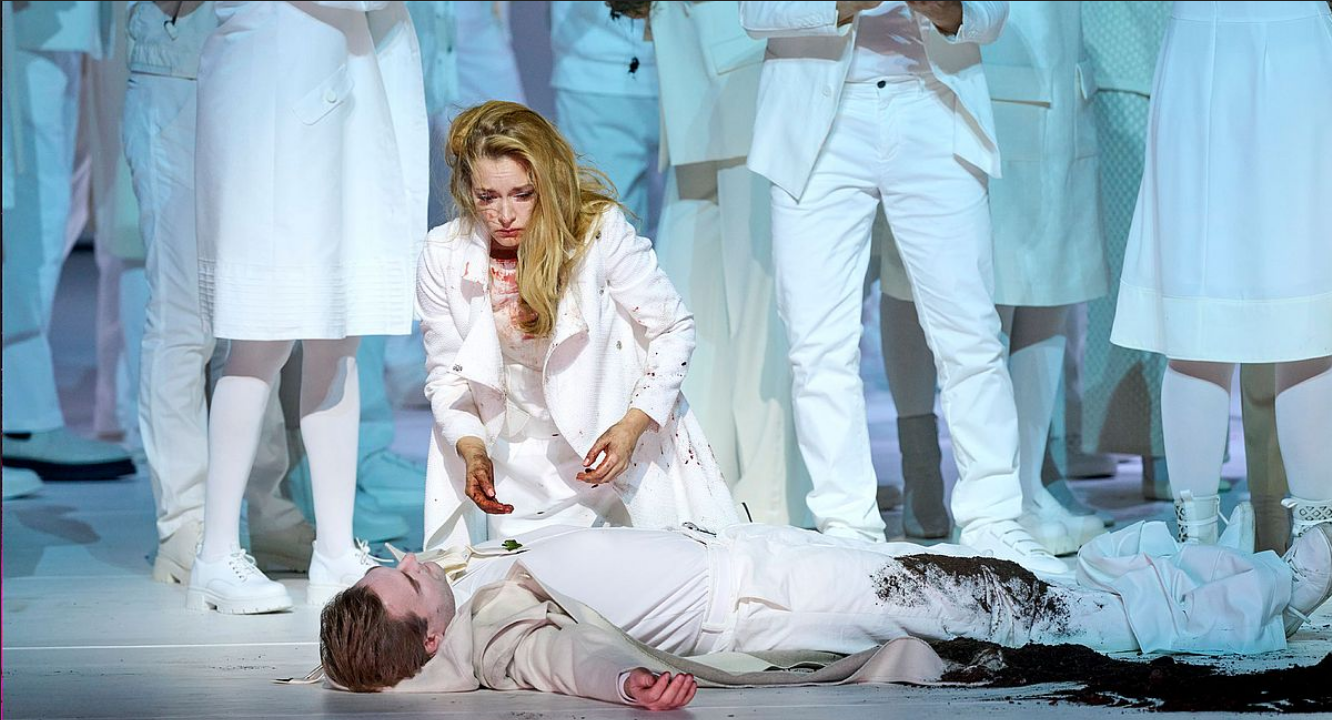
Adès - The Exterminating Angel (Paris, 2024)


Thomas Adès - The Exterminating Angel

Opéra National de Paris, 2024

Thomas Adès, Calixto Bieito, Jacquelyn Stucker, Gloria Tronel, Hilary Summers, Claudia Boyle, Christine Rice, Amina Edris, Nicky Spence, Frédéric Antoun, Jarrett Ott, Anthony Roth Costanzo, Filipe Manu, Philippe Sly, Paul Gay, Clive Bayley, Thomas Faulkner, Ilanah Lobel-Torres

Paris Opera Play - 5th March 2024

When it comes to the films of Luis Buñuel, the ideas and sentiment behind them isn't particularly deep or complicated, but it's the surrealist treatment that distinguishes the works. You could possibly break most of them down to the filmmaker rejecting and making fun of the establishment, the bourgeoisie, the church and their perversions, but he does so in a slightly surreal way that gives them an unexpected character, and a very daring one that challenged many sacred cows. Whether it's Catherine Deneuve as a young newlywed housewife who becomes a prostitute at a high-class brothel in order to enact the deepest sexual fantasies that her young husband is unable to fulfil in Belle de Jour, the story of a nun who resists the lecherous advances of her uncle, renounces her vows and gives his estate over to homeless beggars after his death in Viridiana (including a parody of the Last Supper), some of the images and situations in his films are indelible. None more so than The Exterminating Angel.

Again the idea is a simple one where things seem to go wrong at a dinner party organised by Edmundo de Nobile and his wife Lucia after an evening at the opera. They are surprised to find that the servants are not there to collect the coats of the guests, and this initial upset seems to be the catalyst for throwing the evening into turmoil. The scene is repeated as if to suggest that if the servants, the workers, aren't there to look after them, the upper classes don't know what to do or how to function. They drop their coats on the floor and thereafter everything rapidly falls apart. Enrique drops the hors d’oeuvre ragout, and then Pablo the chief wants to go an visit his sick sister. Even though everything has been prepared, Lucia is outraged. She is going to hold these useless servants to account.

The evening and the celebration for Leticia, the opera singer they call "the Valkyrie", never seems to take off and eventually they each decide to leave. This pleases Lucia, as she intends to conduct a little affair when they go, but somehow no-one seems to be able to leave the room. Perhaps the servants aren't there to open the doors for them. Trapped in uncomfortable proximity with each other in a room they are unable to leave, all the little insecurities they have kept hidden rise to the surface and they find themselves forced to enact them. The further the evening progresses and extends into days, the tensions and pretensions intensify and soon turn from petty arguments and affairs to violence and barbarism.

Buñuel's 1962 film is wildly absurd as it is, so imagine how much more the story must be when Thomas Adès and Calixto Bieito put their stamp on the opera version of the work. The essential theme that must carry over is surely to mercilessly rip into the pretensions of the upper classes and have fun in the process. Subtlety isn't essential, the more extreme the better. Adès certainly has fun introducing strange untypical sounds and instruments like the use of the ondes martenot into the buoyant orchestration. It's as richly and creatively scored as you can imagine, and Adès himself has tremendous fun conducting the Paris Orchestra through it. Yet it is not wild, but controlled, the implication being that the guests haven't lost their minds, they are simply being extreme, or perhaps just unrestrained versions of their true selves.

As a dramatic situation, that is inevitably limited. Taking place in one room where everyone seems to be losing their mind for two hours, the point seems to be made very quickly, and it's just a matter of seeing how far they can push this and what the eventual outcome or explanation for the strange event might be. Inevitably, there is no easy answer and there are many ways of looking at the resultant chaos and the ineffective ways they try to deal with it. The image of sheep - which Calixto Bieito manages to introduce in his own way - suggests conformity and inability to think for themselves to the extent that they are unable to leave a room unless everyone else does, or it could have religious connotations, which are certainly treated with scorn by Buñuel. That is also suggested here, even though the opera version does not include Buñuel's horror in the cathedral epilogue.

Given that, the question must be whether The Exterminating Angel gains anything by being an opera. Unquestionably Adès brings something fresh to the work. Making use of a wide variety of musical instruments and arrangements, it's as musically inventive as you would expect from this composer, finding varied expression for each of the characters, and layering them together with great skill. In terms of transferring those ideas to a stage production, this must be a rare case where the plot of the opera itself has an absurd side that even surpasses what Calixto Bieito usually brings to a production. But then we are talking about Luis Buñuel here, one of the original surrealists, and - while it might not seem like it - Bieito is actually more subtle and suggestive here than the original work. It could be just that the Catalan director has found a work that fits with his own sensibility and indeed I actually would be surprised if Buñuel wasn't a major influence.

If there is one slightly different stance or slant that the opera takes, it's maybe taking the opera evening aspect of the story and making a little more of the idea of musical resolution. This is there in the original, I seem to recall, but unsurprisingly perhaps it takes on another meaning when it is seen in the context of an opera itself, the guests seemingly unable to move until the unfinished playing of Paradisi by Blanca on the piano is brought to a conclusion. As if having to acknowledge that, Adès self-references his own music trapping the guests, and scores the opera singer at a higher pitch than the others, in the same range as Ariel in his version of The Tempest. The finale then, rather than follow Buñuel's cathedral ending, has all the surviving guests emerging dazed from the room, confronting their inner selves and suggesting (in my mind anyway) that the audience do likewise. You must wonder what the audience in the expensive seats at the Bastille make of it, and if that's the only intention in bringing The Exterminating Angel to the modern opera stage, it is surely justification enough.

While occasionally it seems like (controlled) chaos on the stage, there are actually many little touches in both the music, the direction and the singing performances to keep things moving along and give the viewer much to think about. Each of the characters have their own hang-ups and ways of dealing with being locked in that reveals another aspect of the society that the original creator wants to expose and mock. The singing alone is striking enough to grab your attention. There is an exceptional cast assembled here, and each have their own distinctive part to play. It's hard to just pick out one or two in a cast that includes great performances from Nicky Spence, Christine Rice, Philippe Sly, Anthony Roth Costanzo, Paul Gay and Clive Bayley, but Jacquelyn Stucker is exceptional as Lucia di Nobile, Claudia Boyle delivers an impressive lament/lullaby late in the opera for Silvia's son Yoli and Gloria Tronel hits those stratospheric heights as the opera singer Leticia.


Wednesday, 12 October 2022

Mahler - Von der Liebe Tod (Vienna, 2022)


Gustav Mahler - Von der Liebe Tod

Wiener Staatsoper, 2022

Lorenzo Viotti, Calixto Bieito, Vera-Lotte Boecker, Monika Bohinec, Daniel Jenz, Florian Boesch, Johannes Pietsch, Gabriel Hoeller

Wiener Staatsoper Live Streaming - 7th October 2022

To somewhat stretch a metaphor, the idea of a Mahler opera is a bit like waiting for a bus around these parts. It can feel like you are waiting for a hundred and fifty years and then suddenly two of them come along together. Since of course there is no such thing as a Mahler opera that's even more unexpected, and it's perhaps no surprise that the directors daring to stage Mahler's symphonic and lieder works as opera are two of the most ambitious and controversial of contemporary directors; Romeo Castellucci and Calixto Bieito. As strange as it might be to imagine Mahler staged, it's even stranger that such an idea in these times is deemed controversial enough to upset a few sensitive souls who don't even have to watch it or let it impinge upon their favourite Mahler recordings on CD.

While that might not exactly be the primary intention of these directors to upset anyone, there is certainly something of a desire to stir things up - but in a good way, or perhaps a necessary way. Because these are indeed the times we are living in; a time of war in Europe, a time of global pandemic killing millions, a time of looming environmental crisis and climate change that does indeed affect everyone. It's not enough in these times for an artist to remain detached from that, but there should be some recognition that great art is drawn from such dark times and experiences, and it should reflect them and not gloss over them.

In the case of Castellucci's production of Resurrection, for example, it's not enough to just put on a work of such sublime creativity and feeling as Mahler's Sixth Symphony as a concert performance for a wealthy audience at the Aix-en Provence festival. It would almost be an injustice to Mahler to present such a work as a rich indulgence. It's a profound work that has deeper meaning and if it can move an audience - whether to applause or booing - then it ought to provoke such a reaction. Anyone however who boos the imagery of the digging up of a mass war grave while such atrocities are happening for real at that moment not so far away should really think twice about their understanding and purpose of the arts.

The same goes for anyone who manages to work themselves into a state about a creative artist taking a similar approach to this Vienna State Opera stage production of another Mahler's work. Von der Liebe Tod actually consists of two Mahler works brought together, Das Klagende Lied, a cantata from 1879/80 based on the Brothers Grimm fairy tale, and Kindertotenlieder from 1901/04, based on a poem by Friedrich Rückert. Calixto Bieito employs similar techniques to Romeo Castellucci, the two directors almost crossing over as they progress from what were not ever exactly conventional opera stagings in the first place to rather more abstract presentations of works that were never intended to be fully staged.

I say never meant to be fully staged, but the question that arises immediately when watching the first part of this production, the cantata Das Klagende Lied, is why not? It has a clear fairy tale narrative and powerful accompanying music and singing that is dramatically attuned to the developments and deeper sentiments of the story. It's mostly narrative based admittedly, and doesn't even have clear individual roles that you might find in an oratorio, but it is filled with imagery that deserves to exist more than in the mind of the individual listener. In fact it is the role of a director - much as some would seek to not credit him or her with any importance - to explore a work closely and relate it to universal concerns that any listener will recognise and identify with.

Calixto Bieito then evidently doesn't go in for straightforward naturalism or literal illustration of the story in the way of Otto Schenk's The Cunning Little Vixen at the same opera house, for example. The imagery Bieito devises for this fairy tale opera/cantata however is exactly what a director should do when confronted with a work of great art and that is to dig deeper into the underlying meaning of the fairy tale and relate it to more universal concerns. Using the red flower of the fairy tale, the imagery of the willow and the nightingale, all of them witnessing the killing of one brother by another, the overriding idea - for me at least - appears to be the impact violence has on individuals, on society, on nature. And yes, that is something we can see in many aspects of the times we are living in.

As he is wont to do, Bieto simultaneously makes this beautiful to look at but harrowing at the same time, refusing to prettify the underlying horror at the heart of the tale (see also his response to the not dissimilar fairy tale story of men dying for a cold hearted queen in his version of Turandot). In the story, the minstrel comes across a gleaming bone in the woods that he carves into a flute, but here he hacks off an arm, cuts out a bone from within the flesh and plays on a blood spattered bone. It's not the 'flute' that sings either, but the grim spectacle of the dead boy with a bloody hacked off arm singing of his fate. Evidently, this will not be to everyone's taste, but it is necessary.

The dead boy slayed by his brother over a flower leads beautifully into the second part of Von der Liebe Tod, the ruins of the wedding feast turning into an abandoned playroom for dead children in Kindertotenlieder. Conceptually this is marvellous, the earliest of Mahler works - Das Klagende Lied his Opus 1 composed when he was 19 - brought together with the later, final work of a composer capable of committing all his lived experience in the meantime into it; a fairy tale turned into reality and that reality and horror concentrated and transformed into something beautiful through art. That is the purpose of art, or one of its many purposes. It's that same art in musical performance and interpretation that ensures that such work lives on, remains vital and alive and connected not to past events, but to what people are experiencing today. Sometimes life mirrors art in shocking and unexpected ways. One need only think of another recent tragedy in Thailand to see how deep feelings run in Kindertotenlieder. The idea that anyone could even think of mindlessly heckling artists on a stage after viewing this is unconscionable.

It helps that musically this is a glorious affair. The influence of Wagner on the youthful Mahler is most pronounced in the considerable orchestral forces and choral arrangements employed in the service of emotional and dramatic content of Das Klagende Lied. The conducting of the works by Lorenzo Viotti also comes to the fore in Kindertotenlieder, with intense, heartfelt singing from Florian Boesch and Monika Bohinec. How much more alive does this become when such performances are aligned with visual imagery and artistic direction that meaningfully connects the work with reality, that doesn't sugarcoat it or diminish its sentiments, as some might be tempted to do with these two particular works. Welcome to the opera stage of the 21st century, Gustav Mahler.

Thursday, 14 July 2022

Prokofiev - The Fiery Angel (Madrid, 2022)


Sergei Prokofiev - The Fiery Angel

Teatro Real de Madrid, 2022

Gustavo Gimeno,Calixto Bieito, Ausrine Stundyte, Leigh Melrose, Dmitry Golovnin, Agnieszka Rehlis, Mika Kares, Nino Surguladze, Dmitry Ulyanov, Josep Fadò, Gerardo Bullón, Ernst Alisch, David Lagares, Estibaliz Martyn, Anna Gomà

ARTE Concert - April 2022

Based on a Symbolist work by Valery Bryusov with autobiographical experiences that were shared to some extent by the composer, Prokofiev's The Fiery Angel is one of the most impressive and original works of opera I've come across. Musically and thematically it is quite unlike anything else in opera and each new production - although they aren't that common - always suggests new ways of looking at it. There have been some interesting perspectives taken on the work in recent years in Munich, Aix and Rome, but the idea of seeing what a director like Calixto Bieito can make of it is always going to be an intriguing proposition. It turns out that the Madrid production of The Fiery Angel doesn't seem to have a whole lot to say that is new, but the opera nonetheless remains fascinating, particularly with Ausrine Stundyte again taking on the mesmerising role of Renata. 

Sure, in some respects you can see Renata as a typical opera heroine abused and mistreated and misunderstood by the men in her life, her behaviour out of step with society around her, but in the case of Renata, there is indeed quite a bit to misunderstand. Not that her state of mind is any excuse for the abuse she endures or indeed the exploitation of her vulnerability, but fundamentally does seem to be the rationale for the irrational here. Because for whatever reason (there are hints and suggestions but nothing is made explicit), Renata is indeed not functioning on a rational level. Whether a victim of childhood abuse or suffering from schizophrenia, she has clearly been scarred by her childhood experiences, experiencing visions of a celestial being appearing in her bedroom, a fiery angel who becomes intimate with her.

This unfortunately sets her up to become a victim to be further exploited by the men she meets. She lets herself be taken in by Count Heinrich, who she believes is the angel Madiel in a corporeal form, and his eventual rejection only deepens her trauma. Even the noble knight, Ruprecht who comes to her aid in her distress, sees a vulnerable woman he can exploit sexually. His behaviours and actions are suspect, but when he is rejected he does at least try to consider his better nature and help, although it seems to be primarily because he is still fascinated by this extraordinary woman. With his assistance, Renata is exploited even further by charlatans and astrologers, as she tries to find a way to Madiel through occultism and mysticism. 

On one level then it is a familiar situation of a woman being exploited and shunned by a conformist society, leading her to seek answers elsewhere, but The Fiery Angel is also a work that seeks to explore the far reaches and complexities of human experience, Renata's journey being one to get in touch with a spiritual dimension or existence of life outside of the common experience. She has a sense of having touched on forbidden knowledge and seeks to press it further. For Ruprecht too, there is even a fascination for the mystery of a woman that Renata represents. She stirs up a riot of feelings that involve lust, compassion, fear, jealousy and possessiveness. Combined, The Fiery Angel is an exploration of human dualism, what it means to be human, a material physical being with a spiritual mind, mortal creatures with aspirations of an eternal afterlife. On an everyday level grappling with this dualism extends to male and female divisions, base instincts and a higher purpose, purity and corruption, subjective and objective realities.

In other productions by Mariusz Treliński at Aix-en-Provence and Emma Dante in Rome, the stage directors have sought ways to bring the otherworldly level of the opera expressed in the music to the fore, whereas Barrie Kosky's Munich production highlighted the comic absurdity. Calixto Bieito takes a surprisingly much more down to earth approach, seeing the opera very much as an opening into the mind of a woman rejected for not conforming to the expectations of society. It's even set (restricted I feel) in a specific period, the 1950s, before a more general liberalisation and a sexual permissive society. Initially we see Renata seeking mystery in the spinning of a bicycle wheel, creating patterns, the bicycle perhaps alluding to a childhood trauma. The set meanwhile consists of a block of compartments that, as occasional projections of Ausrine Stundyte as Renata illustrate, are representative of the idea that we are seeing into her mind.

Those rooms or compartments are mostly bare empty rooms, ready to be filled with horrors, each in their own little world, none of them connecting up to form any coherent view of reality. Significantly, perhaps rejecting any idea of a spiritual realm beyond physical reality, the few rooms that are decorated, the only lights in the darkness, are related to Agrippa von Nettesheim who in this version is less of a sorcerer than a physician, a man of science who is aware that we are still far from having all the answers. Her childhood bedroom, the source of her trauma, is also shown in all its horror. With an older man appearing, there is the suggestion of abuse by her father, who she looks up to. She sees Heinrich, an older man, as a substitute for her father, but inevitably that is a terrible mistake that only deepens her trauma. The tavern scene with Faust and Mephisopheles pushes Renata to her limits, and is quite disturbing in its own way. As she disturbs the community of nuns in Act 5, there are correspondences with Penderecki's opera Die Teufel von Loudun, which also featured Ausrine Stundyte in a recent Munich production.

Prokofiev, in a work long laboured over that he never saw performed in his own lifetime, strives to find similar expression in the music for the tangible and intangible, and it truly is a remarkable endeavour. The music is powerful and dynamic, sweeping between sensual and disorientating, evoking objective and subjective realities. I think its complexities came across better in the Rome production, but that might just be that the recording benefitted from superb High Resolution sound mix on the Blu-ray presentation. Here, conducted by Gustavo Gimeno, the detail isn't all there, nor the same dynamic shifts of tempo and volume.

Where the opera really comes to life however here in this Madrid production is in the singing performances. Once again - a revelation in the same role in Aix-en-Provence - we have a marvellous performance by Ausrine Stundyte. It's a role that has considerable vocal challenges but there are dramatic challenges too that require expression beyond the external, a requirement for Renata to be possessed of a deep and mysterious inner life. Bieito makes it physically challenging too and Stundyte is again impressive. Leigh Melrose is also excellent, his Ruprecht grappling with things beyond his comprehension and his own limited knowledge and experience. He brings that out in a similarly committed physical performance. 

The origins of the work and its Symbolist trappings leave a lot of room for analysis in The Fiery Angel, but it seems like the controversial Catalan director Calixto Bieito uncharacteristically seeks to demystify the work and restrict its possibilities. In his hands it does indeed boil down to familiar opera themes of a woman with unconventional individual behaviours being shunned by a closed society, moulded to conform and eventually destroyed by it. Prokofiev music suggests a wider context, but in that dialectic between the score and stage representation, the opera still works and weaves its fascination. Principally of course its real human level is expressed by the singers, and with prior experience of these roles, Stundyte and Melrose are thoroughly convincing.


Wednesday, 4 May 2022

Wagner - Tristan und Isolde (Vienna, 2022)


Richard Wagner - Tristan und Isolde

Wiener Staatsoper, Vienna - 2022

Philippe Jordan, Calixto Bieito, Andreas Schager, René Pape, Martina Serafin, Iain Paterson, Ekaterina Gubanova, Clemens Unterreiner, Daniel Jenz, Martin Häßler, Josh Lovell

Wiener Staatsoper Live - 27 April 2022

All of Wagner's mature works have their own particular qualities and strengths, and his final work Parsifal may well be the pinnacle of all opera, but nothing matches Tristan und Isolde for sheer sustained intensity. Some will be dismayed at the often controversial - more often baffling - concept and aesthetic of Calixto Bieito's stage productions being imposed upon such a work as Tristan und Isolde under the current administration of the Vienna State Opera directed by Bogdan Roščić. If you are able to get past this however, it's surely possible to recognise that the director has nonetheless found his own way of tapping into and representing the essential inner strength and intensity of a piece that should never fail to challenge.

If you can get the intensity of the inner emotional content of this opera across not just at the love potion conclusion of the first Act, but can even create that intensity from the outset and build it up to that conclusion, you're are definitely in tune with the intent of the work. There may not be a ship at sea but water does play a part throughout. Act I is a fairly sparse affair, looking like it takes place in an Irish fishing market with a couple of shallow pools of water, sluice channels, on the darkened stage while blindfolded children sit on rows of swings. There is evidently a lot of psychopathology to unpack as far as the red-haired Irish princess in her green polka dotted frock is concerned, and Isolde wields her history, her family, her regal position and her Irish heritage as a weapon to unleash against the betraying Tristan and her own self-betrayal.

Not only has she healed and fallen in love with the man she later discovers is responsible for killing her betrothed Morold, but Tristan is now bringing her as a 'tribute' to be married to his uncle King Mark of Cornwall. That outpouring of loathing and self loathing is fully felt on the stage here, with a duffel coated Tristan right there in front of her and subjected to her fury as he rolls around in the shallow waters. Such is the power and intensity of Martina Serafin's Act I performance that you don't need a love potion for it to develop into something dangerous, and indeed - since it's Bieito, there obviously isn't a flask as such. Each drink the frustration, rage, anger, delirium and love out of the hands of the other, while Brangäne walks past carrying a fish in a plastic bag in each hand. There's nothing of elevated medieval royalty about this, the production demonstrating more that it is an exercise in the human capacity to elevate themselves though love, and for love to exceed human boundaries.

Act II similarly avoids any more typical depiction of Isolde and Tristan's ill-advised and not so surreptitious encounter together, the two instead appearing in separate floating rooms - the more earthbound Brangäne scaling and gutting a fish - that they proceed to tear down. It's simple enough symbolism, the lovers rising above the earth, still trying to strip away any physical boundaries and mortal impediments that would prevent them achieving a union of perfect bliss. All the jumping around, tearing books and unbuttoning dresses does distract and impede the singers a little from fully getting across the emotional depths to which they are wrapped in each other.

At this stage however, union is of course not possible, the two of them still in separate rooms, distinct corporeal entities, unable to consummate that union on any physical or earthly plane. The necessary impossible intensity of this situation is still fully felt, and King Mark's arrival almost seems a welcome appearance that prevents them from spontaneous combustion. Much as I still enjoy seeing what René Pape brings to this role, his grave intoning precisely what is needed here, it has to be said that he is no longer the force he once was and it's beginning to show. The dynamic that he brings however is still effective as Tristan is not struck down by Melot in this scene (both Melot and Mark are sidelined as minor figures in this production), but attempts to perish by his own hand, Isolde attempting to join him.

Despite the usual provocation of full-frontal nudity - a wall of naked male and female figures slowly advance and decorate Kareol like statues, many in embrace - Calixto Bieito otherwise plays out Act III without any significant reworking of Wagner's mood and mysticism. Andreas Schager's Tristan is a bloodied, agonised figure, his anxiety and longing matched in intensity only by Iain Paterson's faithful Kurwenal here. Tristan expires on an overturned table, which is righted by Isolde who sinks to her own love-death reaching out across the table to him. It's an affecting moment however you play it.

The part that Philippe Jordan's conducting of the Wiener Staatsoper orchestra plays in this can't be underestimated. It's a perfectly controlled affair, unleashing forces in response to the stage directions, working in accordance with them, ensuring that everything seen or suggested is brought out with full impact. The performance of Andreas Schager should also be acknowledged. Any prior reservations about his singing or acting abilities are quickly dismissed as he makes a huge impression in Act I, conflicted between his heroism, his love and his betrayal. Already everything that needs to be put in place has been firmly established right from the start, the direction working beyond the surface to bring out all the competing, conflicting forces, the love/hate and love/death paradoxes. He carries this through to Act III with complete commitment. Much the same goes for Martina Serafin's performance. It's perhaps not as strong and consistent vocally, but she is utterly engaging and no less impressive alongside Schager as Isolde.

Any reservations put forward by naysayers quick to denounce anything challenging that strays too far from the familiar are also easily countered. Some will still complain at anything Calixto Bieito turns his hands to, but I would be amazed that anyone could fail to be moved by what takes place on stage and in the pit in this production, or seriously believe that the stage direction takes anything away from it. Jordan's conducting finds the rhythms and moods well, and Schager and Serafin's interpretation of Tristan and Isolde is deeply felt. Regardless of what you make of the strangeness of the set designs, there is little doubt that Bieito's direction of the cast/actors has been instrumental in achieving that, and the fact that the Vienna production carries the force of the work entirely should be abundantly clear.

Friday, 9 July 2021

Stephan - Die ersten Menchen (Amsterdam, 2021)


Rudi Stephan - Die ersten Menchen

Dutch National Opera, Amsterdam - 2021

François-Xavier Roth, Calixto Bieito, Kyle Ketelsen, Leigh Melrose, Annette Dasch, John Osborn

ARTE Concert

Many German and Austrian composers of the late Romantic period had their careers cut short by the wars that scarred the first half of the 20th century, but unlike the composers who fell foul of the Nazi regime, antisemitism and opposition to decadent subject matters in their opera compositions, Rudi Stephan's promising career was brought to an abrupt and tragic end at the age of 28, shot after only 16 days as a conscripted soldier on the Russian front in 1915. His only opera Die ersten Menchen (The First Humans), completed in 1914 at the start of the war and performed for the first time five years after his death, is one of the great 'lost' major works of this period, Stephan's untimely death consequently representing another great loss to the opera world suffered during these years.

It might sound like it has a Biblical subject, but subtitled 'An Erotic Mystery', Die ersten Menchen's story of Adam and Eve taps into the similarly controversial subject of taboo lusts and violent desires that Richard Strauss had recently explored in his extension of the musical language of Salome and Elektra. And since we're effectively dealing with the Garden of Eden, with references to creation and procreation of the human race, with gardens of lush fruits and rising sap, blooming flowers and forbidden fruit, we're evidently dealing with similar archetypal forces and images, likewise brought to vivid and colourful expression in Stephan's music score for the opera.

And indeed the woman, Chawa (Eve) sees the role of procreation and populating the earth as the primary purpose of her nature and being, identifying with the Spring season. Adahm (Adam) on the other hand identifies with Autumn, seeing his work as having ripened and come to fruition, at a stage in a cycle that needs nurturing and renewal. Their sons Kajin (Cain) and Chabel (Abel) each have their own urges and differing natures. It's too much for Kajin to handle, and his mind gets twisted, his head filled with tormenting desires that he is unable to control, lusting for a wild woman, for pleasure and gratification. Chabel on the other hand seeks a higher spiritual purpose in his contemplation of the universe, the infinite and the eternal God.

Adahm and Chawa are swayed by the beauty of Chabel's vision, expressed as much in the soft soaring lyricism of his voice as it is in the beauty of the imagery he evokes. His visions are persuasive, but in their own way as demented as Kajin's, whose lusts eventually drive him towards his own mother. Like any work that deals in archetypes - and they don't come much more significant than Adam and Eve - there are degrees of emphasis and interpretation. Stephan, and the original work, all suggest that there are disturbing elements to any fanaticism, to a singular vision, and that a balance is necessary - and evidently, this reflects to some extent the world in which Stephan was living at the beginning of another war that would engulf Europe and so quickly bring about his own death.

The director Calixto Bieito doesn't need to set this in the Garden of Eden to highlight or give emphasis to the Biblical association of the work or Stephan's treatment of playwright Otto Borngräber's controversial play and libretto. Some of it might seem silly, such as Chabel sacrificing a cuddly toy that spurts blood, but there is something disturbing in this and it is no less effective for its refusal to conform to hackneyed imagery that may no longer hold impact and meaning. Nor, since the strength of the work lies in archetypes, in the psychology, in the pathology, in the music - does it need elaborate set designs and high directorial concepts to make it come alive and speak directly to an audience.

The reconfiguration of the Amsterdam opera house for social distancing presents Bieito with new ways of staging the work. Since this opera calls for a large orchestra that could hardly effectively distance in an orchestra pit, the orchestra are spread out in tiers at the back of the stage behind a transparent screen. The director makes good use - not overuse - of the screen by projecting overhead camera angles and other imagery that works with and intensifies the drama, such as it is. The family unit is suggested by a house-shaped lightbox and a dining table bearing a colourful array of ripened, rotting and crushed fruit juices and seeds. If the intention - borne out by the over-ripe music - is to show an orgiastic descent into decadence and murder, the director gets the messy madness of the first family across, and it doesn't say much for the origins of the whole human race.

Whether - like Wilde's 'Salome' - the libretto actually says anything subversive and meaningful about a corrupt society with violent dangerous lusts that hides behind a facade of respectability, or whether it just strives for similar poetic colour and controversy, Stephan matches the tone of the libretto as successfully as Strauss adapts Wilde with necessary overstatement. What it does clearly get across with some measure of success is the enormity of the very first experience of death, matching that significant first death of a human, slain by his brother with the true horror of the death of so many others to come at a time when war has just broken out, a war that will very soon kill see the composer also killed by his "brother".

Alas! A great red wave is rolling this way!
Human bones float in it, doleful skulls, a quivering heart
The future blood of future humanity!
The thousands of men slain by their human brothers!

The music lives up to the grandeur of the language (exclamation marks aplenty!) as well as the indescribable horror of the setting. François-Xavier Roth conducts the orchestra through the glorious dramatic sweep of Stephan's score, which is truly ravishing. If the significance of the characters and the text of the libretto is a little obscure in places, the musical setting of the voices by Stephan is also impressive, pushing the performers to full expression. John Osborn gets a plum role as the lyrically soaring Chabel, which he delivers superbly, as always. Kyle Ketelsen's Adahm and Leigh Melrose's deeper conflicted Kajin are just as impressive in their respective roles.

Comparisons to Strauss's Elektra are most felt at the start of the second act of Die ersten Menchen, where Chawa feels the isolation of her position, the loss of a family turned inward against itself and lets out her frustrations in a howl of rage. It's consequently similarly challenging on a dramatic soprano vocal level to cut through the vast orchestral forces and Annette Dasch plays it well, certainly pushed at the higher range, but retaining that fine measure of lyrical expression that is characteristic of her voice.

Links: Dutch National Opera, ARTE Concert

Sunday, 16 December 2018

Verdi - Simon Boccanegra (Paris, 2018)


Giuseppe Verdi - Simon Boccanegra

L'Opéra National de Paris, 2018

Fabio Luisi, Calixto Bieito, Ludovic Tézier, Mika Kares, Maria Agresta, Francesco Demuro, Nicola Alaimo, Mikhail Timoshenko, Cyrille Lovighi, Virginia Leva-Poncet

Paris Opera Cinema Live - 13 December 2018

Verdi's mature period operas have always been problematic, their dramatic plot lines never quite keeping up with the growing maturity and sophistication of the composer's musical writing or compromised by Verdi attempting to rework material to suit French grand opera needs. As far as Simon Boccanegra is concerned, it's another case of rewriting, but rather than revisiting an earlier work first performed in 1857 to suit a new audience 23 years later, Verdi seems to be working to his own musical imperative, drawing deeper on his own experiences of family struggles and his observations of human nature during the upheaval of the Italian Risorgimento.

As a consequence, Simon Boccanegra is quite unlike other Verdi works, seeped in a tone of deep sombre melancholy that only the darkest passages of I due Foscari and Don Carlos can come close to matching. Recognising the failings in Piave's original libretto, Verdi enlisted the services of Arrigo Boito, with whom he would craft his late masterpieces, and Boito does bring a greater poetic touch to the work and human feeling to the sentiments, but the themes remain essentially the same as those consistent throughout Verdi's operas - love versus duty and one's responsibility towards family versus the people and the nation as a whole.


The reworking of the material however leaves the problem of Simon Boccanegra consisting of a patchwork of scenes with leaps in time periods and gaps in the drama, and when staged it just never seems to flow or hold together despite the insistent tone and musical language employed by Verdi. And it really is music on another level, separated by a vast gulf from those early works. The youthful force and drive is still there, but the difference here is that it expresses internalised drama rather than underscoring melodramatic plot developments of war, vengeance, fate, padded out with popular laments, pleas to god, and drinking songs.

It's a little unfair to characterise Verdi in those terms, but it just illustrates how far Verdi's ambitions and ability have moved on from the standard template and from the necessity of writing to meet the expectations of an audience. Some of those problematic dramatic elements remain in Simon Boccanegra of course, and it seems unlikely that a director like Calixto Bieito would really want to or be able to make anything convincing out of them. Somehow however, without denying all the colour, drama, fury and sensitivity that makes up a Verdi opera somehow Bieito lays open Simon Boccanegra in his Paris Opera production in a way that somehow gets to the heart of it. It's an absolutely stunning experience.


Once you get rid of the period accoutrements and costumes of 14th century Genoa, and once you dispense with the distractions of the plot and the near impossibility of making it seem credible, there's room to look for the deeper sentiments at the heart of Simon Boccanegra. Susanne Gschwender's set designs, the stage stripped of everything but the huge skeleton of the hull of a ship that revolves to show us what would appear to be a representation of the mind of Simon Boccanegra, the Doge of Genoa. Seen lying prone on the floor, a position he also takes having been poisoned in Act II, it's tempting to see the fractured narrative and its strange outpourings of emotion and grief as that of a fevered mind of a former corsair viewing it in a heightened state.

And that works well for a narrative as fractured as Simon Boccanegra. Bieito is then able to introduce a vital element that is usually absent from the dramatic presentation of the work but which is ever-present in Verdi's music; Maria. The association of news of the death of Maria at the very moment that he is proclaimed Doge creates a fusion that haunts Boccanegra. It doesn't just cause problems with Maria's father that lead to political plotting and family feuds, but - along with the disappearance of Simon and Maria's daughter - it's also something that has a deep personal impact on him, a melancholic yearning associated with his office that remains with him all his life.

That sentiment is what you can hear when you hear the music that Verdi has composed for the opera, and it's there from the very first note, Fabio Luisi drawing the darkness out of the detail and the silences in the score. It's appropriate then that director Calixto Bieito introduces Maria as a ghostly presence throughout the work, even showing her normally off-stage reported death by having her father drag the dying woman onto the stage to confront the husband who let her down. The image is powerful, and Boccanegra cannot shake it. She haunts the ship of Simon's mind as he himself lies dying, caught up in his own melancholic reflection, sadness and regret.


The risk is that this internalised perspective aligned with Verdi's music could push this further over into high melodrama, but by allowing nothing extraneous to distract - much as Verdi's complete stripping away of any dramatic underscoring or ornamentation does - Bieito's production is able to focus on the sheer depth of feeling a father has for his daughter, for his family, for the regrets that have allowed political events beyond his control impinge on their natural development. It's something that Verdi would very much want to express from a personal viewpoint and Bieito's production permits this much better than any version of Simon Boccanegra I've ever seen before.

There's no effort to clarify the complexity of the plot or the gaps in credibility that come with Simon being reunited with his lost daughter, but there is every ounce of emotion put into expressing such longing and such feelings. If there's one place where the value of Bieito's work as a director shows, it's in his directing of the performers to make all those sentiments come to life. There's no opera theatrics here either in the mannerisms of the delivery of the singing; all of it comes from the heart, which might mean it's not quite naturalistic, but in the context of Verdi's music that is simply perfect, unadorned, unguarded, unredacted pure emotion.

As is ever the challenge with Verdi - even in those roles that aren't created purely to show off the abilities of the lead performers - is getting singers capable of handling the considerable vocal challenges that go along with the advances of characterisation in these later operas. If Maria Agresta couldn't always carry the fullness of sound that is needed, there aren't many who can meet the demands of the extraordinarily challenging range required for Amelia/Maria, but her performance was as intense and heartfelt as it needed to be. Ludovic Tézier continues to develop into one of the best Verdi baritones around and gave a commanding performance here, equally intense, equally heartfelt. When you add in the kind of delivery given by an outstanding Francesco Demuro as Gabriele Adorno and the contrast provided by Nicola Alaimo's Paolo, the results were truly shattering.

Links: Opéra National de Paris, Culturebox

Friday, 29 September 2017

Puccini - Tosca (Oslo, 2017)


Giacomo Puccini - Tosca

Den Norske Opera, Oslo - 2017

Karl-Heinz Steffens, Calixto Bieito, Svetlana Aksenova, Daniel Johansson, Claudio Sgura, Jens-Erik Aasbø, Pietro Simone, Ludvig Lindström, Thorbjørn Gulbrandsøy, Aksel Johannes Skramstad Rykkvin

Opera Platform

One of the criticisms that can perhaps be legitimately be made against Tosca is that it is indeed little more than a cheap violent thriller, or a "shabby little shocker" as Joseph Kerman once characterised it, a term that it now wears as a badge of honour. Kerman's other criticisms against it for breaking the so-called rules of opera composition are rather more dubious subjective opinions based on a personal interpretation of what opera should be, but Tosca certainly is a dark, violent piece of verismo whose shock value threatens to submerge any human qualities that might be found in the opera, if indeed you think there are any. You could pretty much say the same about Calixto Bieito's production of Tosca for Den Norske Opera's production in Oslo.

Bieito's rather bleak outlook on the opera then might well be the only really valid way of approaching this work. To take it seriously as a historical piece or even as a strictly realist piece of drama, it's obviously absurd and quite overblown. Whether Tosca has any real commentary to make on historical events or whether it has any insightful point to make about ordinary people caught up in a political nightmare is doubtful. It's safer to think of Tosca as purely a political thriller and nothing more, and on that basis it is undoubtedly a thoroughly effective piece.

Similar criticisms could be made about Puccini's final unfinished opera Turandot, which is a work that seems perversely cruel and rather heavily scored out of all proportion to the opera's fairy-tale setting, and Calixto Bieito likewise focussed on the sinister authoritarian undercurrent that runs through that work in his production of it. Bieito's Tosca is more or less a companion piece to that Turandot, a study in the corruption and brutality of totalitarian rule that crushes individual freedom, going further to explore the repression of the arts within such a regime and the duty of the artist to speak out against it.


"Your silence will not protect you", states the placard wielded by political prisoner and fugitive Angelotti before the Oslo production of Tosca starts, and more so than in Bieito's Turandot where a similar warning was made about the silencing of dissent by artists who dared speak out against a cruel regime, Tosca does indeed deal with two artists - the opera singer Tosca and the artist Cavaradossi - who find themselves forced to take a stance against a cruel regime and address the real issues of its corrupt activities when those issues are brought to their door.

Director Calixto Bieito does his best to make that situation as shocking and as sinister as it is possible to make it on a stage and within this particular work. The audience are subjected to an onslaught of violence for the full three acts of the opera, with no interval to provide a breathing space. It's somewhat stylised and representational, but it still carries the requisite shock value. The Madonna painted by Cavaradossi is not a painting but a real woman, stripped naked, her robe held out as a 'fan' for Tosca to discover. Cavaradossi is brutally tortured on-stage, Bieito makes use of dwarfs in school uniforms for henchmen, and even introduces a son for Scarpia, another schoolboy who licks lasciviously on a lollypop. There's no innocence to be found anywhere here.

Least of all in Scarpia. And, as you might expect, Bieito makes him as vile a character as possible, pawing over Floria Tosca and another woman who we presume is his wife, and Claudio Sgura does his best to make him as repugnant as possible. That's to be expected, but Bieito also seems to want to explore how this corruption also extends to destroy the purity of the artist and how this might even be a necessary thing. This Floria Tosca goes rather further than most before killing Scarpia (bizarrely with his own spectacles rather than a knife) and is fired up by the experience. As Cavaradossi observes those "sweet hands pure and gentle" have "dealt out death".

For Bieito's emphasis to work - if it is even possible to truly depict the horror of a totalitarian state on a live theatre stage and in an opera like Tosca - it needs a Tosca who can respond to it on those terms, reacting to the violation of her integrity with horror and then come to terms with opposing it, even if that endeavour in Puccini's opera is ultimately futile. That, on top of the kind of the role's singing demands is a lot to ask of any soprano, and Svetlana Aksenova struggles somewhat. Aksenova doesn't have quite a big enough voice or personality to carry such a role, but sings well nonetheless. Her acting performance however lacks conviction to such an extent that when Scarpia says his is fired up by the new woman who has explosively adopted a new role he has never seen before, you do wonder what he's talking about.


Aksenova however does come more into the part in Act III when the trauma of the experience seems to tell on Tosca, and it's in this act that the effectiveness of Bieito's direction of the work becomes evident in its relationship with the music. You can't really put the true violence of Tosca on the stage; it's too brutal and it needs the medium of music to translate it. Karl-Heinz Steffens's conducting is a bit light in places when you need more forceful hand and a greater dynamic between the verismo violence and the more idealised human sentiments, such as those sung so beautifully by Daniel Johansson in Cavaradossi's 'E lucevan le stelle'. Half measures won't do and I don't think you can overstate in Tosca; the contrast needs to be there to show the force with which those gentle human sentiments will inevitably be crushed.

Puccini shows no mercy for any of his characters and neither does Bieito. The lighting is harsh permitting no soft colours, the stark bright spotlights picking out the characters in the darkness and throwing shadows. There is no place to run and no place to hide on Susanne Gschwender's sets. Nor is there a place to jump. You can hardly expect Bieito to be as crude as actually having Tosca leap from the Castel Sant' Angelo, but whether it's an acknowledgement that there's only so far you can push such 'realism' before it becomes sentimental or whether the director believes that both Tosca and Cavaradossi have to live at least long enough to acknowledge their actions, Bieto spares them the final famous denouement, but not their torment. Ultimately however, it's Puccini's extraordinary building and contrasting of the musical forces that determines their fate and Bieito follows it to its appropriately devastating conclusion.

Links: Den Norske Opera, Opera Platform

Sunday, 5 March 2017

Wagner - Tannhäuser (Venice, 2017)

Richard Wagner - Tannhäuser

Teatro la Fenice, Venice - 2017

Omer Meir Wellber, Calixto Bieito, Paul McNamara, Liene Kinča, Ausrine Stundyte, Christoph Pohl, Pavlo Balakin, Cameron Becker, Alessio Cacciamani, Paolo Antognetti, Mattia Denti, Chiara Cattelan

Culturebox - January 2017

There are a number of thoughts that come to mind as you try to figure out what the director Calixto Bieito is getting at in his 2017 production of Tannhäuser for La Fenice in Venice; few of them the kind of thing that usually comes to mind when watching this opera or even a Calixto Bieito production. As a director who usually takes a rather extreme reinterpretation of works, the minimalist expression of this Tannhäuser suggests either that he is seeking to strip back the work to its fundamental essence to see whether there's a deeper emotional truth to be found in it or else he is just lazy and running out of ideas.

And, as far as Tannhäuser is concerned, you wouldn't blame a director for thinking that everything that is to be said about the work has probably already been said. It's an early Wagner opera, one that was originally written in 1845 for Dresden, and continually revised by the composer through to its notorious performances at the Paris Opera in 1861. Wagner was never fully satisfied with the work and indeed some of the themes that run through it are revisited with considerably more insight, nuance, experience and ability in Die Meistersinger von Nürnberg. Perhaps trying to find a coherent vision to work with, the Venice production takes Act I from the 1861 Paris version and Act II and III from the original revised Dresden version.

In comparison to Meistersinger, Tannhäuser is indeed somewhat heavy-handed in its treatment of the role of the artist in society, in the struggle between sacred and profane love, in the idea of the suffering artist achieving redemption for himself and furthering the progress of society. It certainly helps if you can find a way to express these ideas on the stage without all the high-flown poetic veneer that comes with the literal approach of Götz Friedrich. Robert Carsen, for example, would put the emphasis on the role of the conflicted artist by showing him as a painter rather than a singer in a Paris production. Claus Guth explored the idea of Wagner as Tannhäuser in Vienna, contrasting idealism with the reality. More recently, Sebastian Baumgarten's art-installation Bayreuth production explored art and the artist as the vital lifeblood of a fully functioning society.

The imperfection within the composition which lies partly within Wagner's blending of several different historical and mythological sources and a developing philosophy of his own, should nonetheless provide plenty of material for a director to work with. If nothing else, the viewpoints that Wagner expresses on the role of the artist within society can surely be tested for validity when exposed and contrasted with the present day. Calixto Bieito of course ditches the historical veneration of Wartburg, stripping it of any period costumes and elaborate realistic set designs and brings it into a more modern world setting. This time however he doesn't seem to impose any specific modern reading or context, but rather reduces it to its essence to see if it stands up and holds any truth or validity on its ideas alone.


Bieito's production of Tannhäuser then has more in common with his production of Halevy's La Juive for the Bayerische Staatsoper. There is something of a Grand Opéra aspect in common in the two works; a tendency towards overblown melodrama and musical overstatement that needs to be counteracted or viewed in a more modern light. There is also a religious sentiment in common in both works that Bieito seems to wish to avoid, at least in terms of conventional iconography, but still wishes to explore in terms of what it reveals about national character, fundamentalism and intolerance. As with La Juive however, it's debatable whether such an approach works or whether in fact it isn't actually missing the whole point of the works where the form is as much a part of the meaning as the content.

Still, it isn't too difficult to establish the contrasts between the three acts in fairly broad terms. Act I is hedonistic indulgence of the pleasures of the flesh; Act II is seeking to find an equivalent spiritual experience that serves a higher purpose; Act III is where the artist is able to reconcile the physical and spiritual sides of human nature and through them redeem society. Bieito's Venusberg in Act I, in contrast to the traditional idea of sinfulness and hedonistic indulgence, is seen rather more in terms of nature, with Venus wrapping herself sensuously in the hanging greenery that is just about the total extent of the scenery. The Wartburg of Act II and the singing contest is seen in a rather more rigid, structured form of frames. Act III's set is a combination of the previous two, but it's not a natural blend and rather seems to have destroyed society rather than united it. Perhaps the destruction of that society is necessary in order to rebuild.

Having established an understanding of the concept in broad terms, Bieito doesn't seem particularly concerned with imposing any other reading or emphasis on the work. Tannhäuser is no gentle work however and there is already emphasis aplenty within the conflicts of opposing natures and ideologies. It's here that Bieito lets the emphasis rest, rather than in some manufactured situation or in some elaborate scenery. Venus's sensual passions are seductively exaggerated by Ausrine Stundyte, Elizabeth's goodness and suffering is expressed fervently by Liene Kinča, leading to Wolfram inexplicably almost choking her in the third act, but primarily all of the conflict and passions and suffering have to be collectively absorbed and then transformed by Paul McNamara's intense Heinrich.


Tannhäuser takes his pleasures and his duties seriously throughout the opera. He indulges in physical love in Venusberg in Act I to such an extent that his willingness to submit to the demands placed on him by his minstrels of Wartburg is equally and wholeheartedly enthusiastic. There are no half-measures in Heinrich's world. In Bieito's direction, there is very much a sense that Heinrich believes that his self-mortification is a necessary stage that the artist must endure. He must suffer for his art just as he reveled in pleasure if he wants to fully explore the limits of being human and use the knowledge gained to question society and challenge its rules. These extreme views are not tolerated willingly by society when Tannhäuser expresses what he has learned in the singing contest of Act II. Nor are they tolerated by religion, as he finds when he submits to another 'trial' and undertakes his pilgrimage to Rome.

Act III then, following all the ferocious clashes of firmly held beliefs and ideologies, has wrought destruction on the once solid foundations of society, and Elizabeth's innocence is the price that has to be paid for it. With Wolfram and Elizabeth making wild empty gestures like they are in death throes, there's a post-apocalyptic feel then to this Act III of Tannhäuser that is less celebratory of the religious mysticism that is more commonly found there. Played this way, with the musical direction under Omer Meir Wellber slowing things down to an almost funereal pace, the tone felt closer to the final Act of Parsifal, emphasising similarities in the redemptive conclusions between the two works that I had never noticed before.

If that's the only revelation produced by Calixto Bieito's production then I suppose there is some method to the direction, even as it seems to work against the nature of Wagner's intent, if not so much the word. I think it might have been more successful an endeavour if it had singers of greater force of delivery than those cast for the La Fenice performances. It's not the kind of full-power singing you normally associate with the work, but the expression is nonetheless all there. Paul McNamara is mostly up to the challenge of the main role, performing with intensity and clarity. Liene Kinča's is equally as intense and gives an impassioned performance as Elizabeth. Ausrine Stundyte isn't quite up to the demands of Venus and struggles noticeably in her Act III scene. I thought I detected some murmuring of discontent from the audience at the proceedings of the first two acts (which wouldn't be unusual for this director), the production and performers are well received at the conclusion, so there's a sense that the power of Bieito's direction hit its mark.

Links: La Fenice, Culturebox